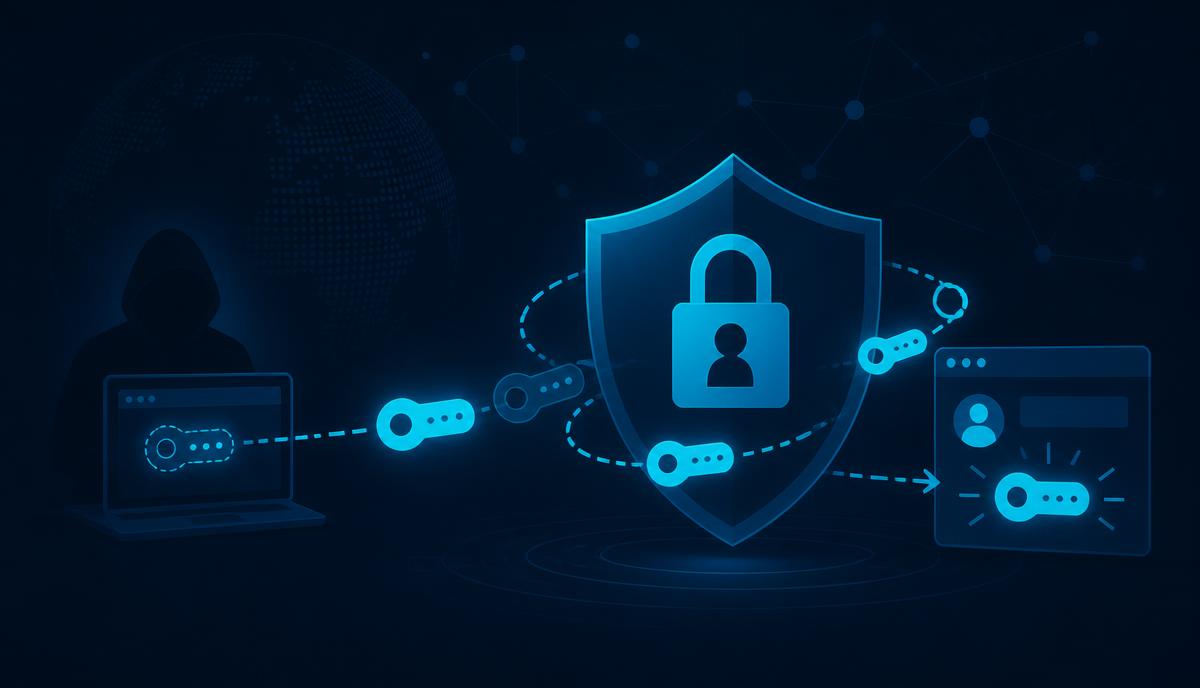
On August 2, 2026, a 7GB dump surfaced on Telegram — not passwords, session tokens. Analysis by Okta counted 44,791 unique tokens harvested from 5,871 infected machines across 162 countries, pulled off victims' devices by infostealer malware. 1,843 of those tokens were still valid and unexpired the day the dump was released. None of them had to defeat multi-factor authentication. A valid session token is proof you already passed MFA once — replay it, and the system has no reason to ask again.
This isn't a 2FA flaw. It's what 2FA was never built to survive.
We've written before about MFA no longer being sufficient on its own — that a cloned voice can now talk its way past a phone-based verification call. This is a different failure mode, and arguably a more dangerous one: it doesn't try to fake the second factor at all. It steals the token your system issued after the second factor already succeeded, then replays it from a different device using anti-detect browser tooling that spoofs the original device's fingerprint. As far as the application is concerned, this looks exactly like the same authenticated session continuing — because, technically, it is.
Even passkeys aren't fully out of reach anymore
Passkeys have been marketed, correctly, as close to phishing-proof — there's no code to intercept, no push notification to approve by mistake. Research published in August 2026 demonstrated attacks capable of recovering synced private keys or otherwise bypassing phishing-resistant MFA under specific conditions. This doesn't mean passkeys stopped being a real improvement; it means "phishing-resistant" was never the same claim as "unbreakable," and the identity threat surface keeps moving up the stack even as each individual layer gets harder to attack directly.
Why this specifically matters if your team uses AI tools day to day
Of the tokens in the August dump, 555 were tied specifically to AI services — Google, Microsoft, OpenAI, Anthropic-related products, Cursor, Character.ai, Poe, and Pika among them — and 24 valid API keys were recovered outright for Gemini, OpenAI, Groq, and OpenRouter. 17.7% of all the harvested tokens contained plaintext personal data. If your team is one of the growing number of small businesses now running daily work through AI coding assistants, chat tools, or API-connected automations — increasingly the case across the SMB clients we work with — every one of those live sessions is a credential an infostealer on a single infected laptop can hand straight to an attacker, no password or MFA prompt required at any point in the chain.
What continuous identity monitoring has to catch that a login check can't
A one-time authentication check at sign-in never sees this, because the attacker isn't signing in — they're replaying a session that already exists. What catches it is continuous monitoring of how a token is actually being used after issuance: a session suddenly active from a new device fingerprint, an unfamiliar IP range, or an access pattern inconsistent with how that token was originally issued, flagged and revoked in real time rather than reviewed at the next login.
This is the specific gap CyberFence's Endpoint & Identity Protection, delivered with Huntress, is built to close — 24/7 monitoring across the full identity lifecycle, not a point-in-time check at the door.
Sources: The Hacker News, "Infostealer Logs Expose Replayable AI Tokens That Can Bypass MFA" (September 2026), citing Okta analysis of an August 2, 2026 credential dump; The Hacker News, "New Passkey Attacks Can Recover Synced Private Keys or Bypass Phishing-Resistant MFA" (August 2026).