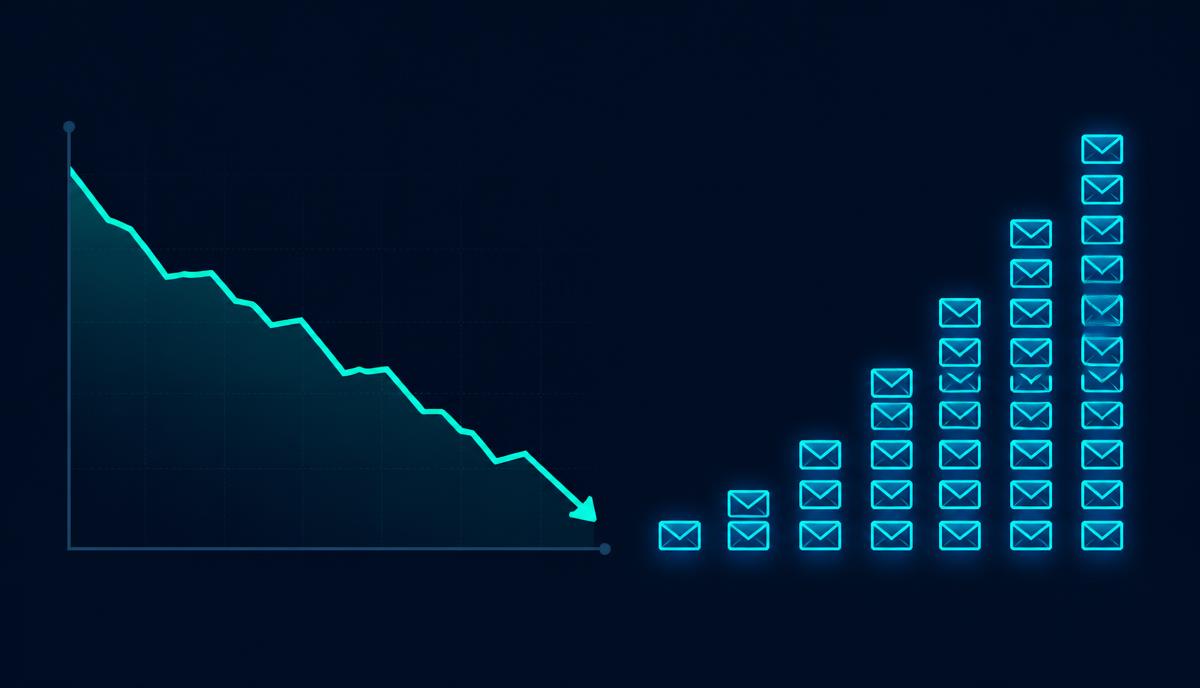
Both of these are true at the same time, from the same report: employees who go through a full year of continuous phishing simulation and training now fall for a test phish only 4.2% of the time — the lowest baseline ever recorded, down from a 33.2% starting point. And phishing attack volume rose 17.1% over the same period. The defense is working better than it ever has. Attackers responded by sending more, not by getting smarter about it.
The number behind the number
KnowBe4's 2026 Phishing by Industry Benchmarking Report, released in July, is the largest dataset of its kind: 42 million simulated phishing tests across 14.8 million users at 64,000 organizations worldwide. The curve it shows is consistent with what we've cited before — a 40% drop in the first 90 days, most of the remaining improvement arriving over the following nine months — but the headline number this year is sharper than in prior editions: 79% overall reduction, down to a 4.2% click rate, is the best result the benchmark has ever recorded. Healthcare still runs hottest at a 42.7% baseline before training starts; large enterprises still start higher than small businesses (39.5% versus 24.7%). None of that has changed. What's changed is how far continuous programs now pull that number down.
Why attackers scaling volume, not sophistication, is the more dangerous shift
A 17.1% rise in attack volume sitting next to a record-low susceptibility rate looks, at a glance, like good news winning. It isn't quite that simple. KnowBe4's own report attributes the volume increase directly to generative AI: cybercriminals producing "highly personalized phishing campaigns, business email compromise schemes, and deepfake-enabled social engineering attacks at scale." When the cost of producing a convincing lure drops to nearly zero, the rational attacker response isn't to craft one brilliant email — it's to send a thousand good-enough ones and let the numbers work. A 4.2% susceptibility rate against a static volume of attacks is a real win. The same 4.2% against 17% more attempts is a materially larger number of employees who still click, in absolute terms, even as the program is objectively succeeding.
An average is not a guarantee, and attackers only need one exception
4.2% is a company-wide average across a full training population. It says nothing about the one employee handling wire approvals, the one with standing access to your client database, or the one an attacker has specifically researched before sending anything. A generic, at-scale phishing campaign is exactly what continuous training is now very good at stopping. A targeted attempt against a specific high-value employee, built with the same AI tools but aimed rather than broadcast, is the harder case — and it's the one where per-person risk scoring and adaptive, gap-specific training actually earn their keep over a flat, one-size-fits-all program.
What this means for a program running today
Don't read a falling average as a reason to ease off cadence. Read it as evidence that continuous, adaptive training is the one control category currently keeping pace with AI-scaled attack volume — and that the next improvement to chase isn't a lower company-wide number, it's closing the gap on the specific people whose risk score hasn't moved.
Source: KnowBe4 2026 Phishing by Industry Benchmarking Report (released July 7, 2026; 42 million simulations, 14.8 million users, 64,000 organizations).